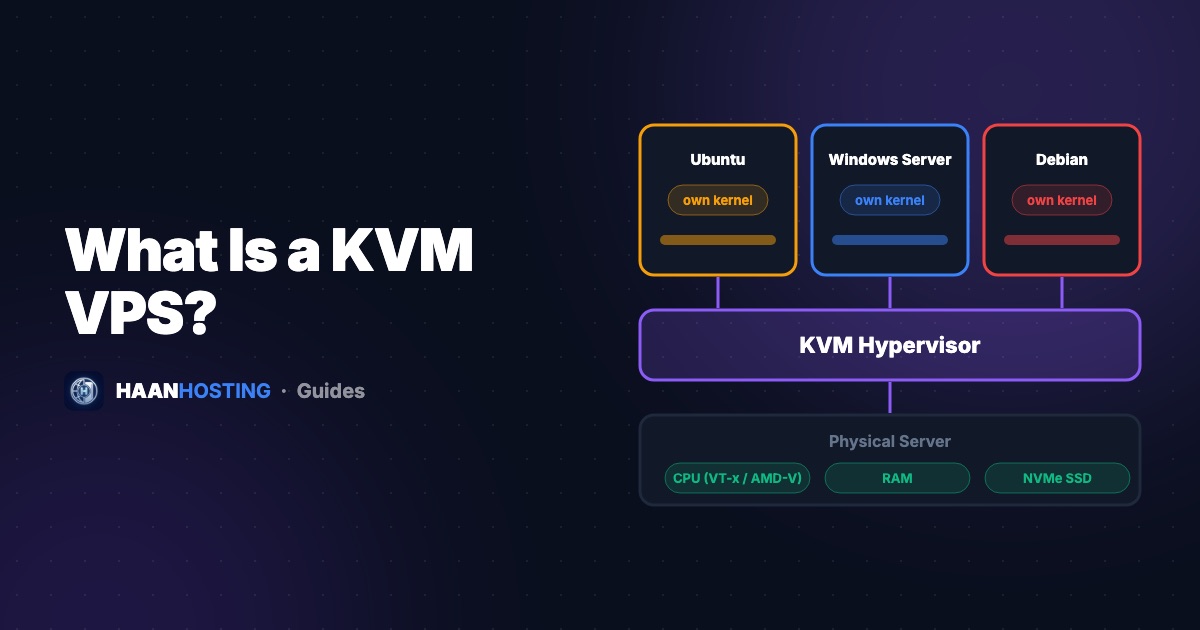
Two VPS plans can list the same "4 cores, 8 GB RAM" and still perform completely differently. A big reason is the virtualization technology underneath. KVM has become the standard for serious VPS hosting because it gives each server real isolation and guaranteed resources. Here's what KVM is, how it compares with container-based VPS such as OpenVZ, and why it matters for your website or RDP.
What is KVM?
KVM (Kernel-based Virtual Machine) is virtualization technology built directly into the Linux kernel. It turns a physical server into a hypervisor that runs multiple fully independent virtual machines. Each one has its own virtual hardware, its own kernel and its own operating system.
KVM uses the hardware virtualization features in modern Intel (VT-x) and AMD (AMD-V) processors, so virtual machines run at near-native speed. It powers a large share of today's public cloud infrastructure.
What is a KVM VPS?
A KVM VPS is a virtual private server running as a full virtual machine on a KVM hypervisor. In practice, it behaves like a small dedicated server:
- You can install any operating system: Ubuntu, Debian, AlmaLinux, or Windows Server
- You get your own kernel, so you can load kernel modules, run Docker and use custom networking or VPNs such as WireGuard
- Your RAM is allocated to you, not borrowed from a shared pool
- Other customers on the same host can't see or touch your processes or files
KVM vs OpenVZ (container VPS)
OpenVZ and LXC are container-based virtualization. All "VPSs" on a host share the host's single Linux kernel. Containers are efficient, which is why they enable very cheap plans, but they come with trade-offs:
| Feature | KVM VPS | OpenVZ / container VPS |
|---|---|---|
| Virtualization type | Full hardware virtualization | OS-level containers |
| Kernel | Your own kernel | Shared host kernel, can't change it |
| Windows support | Yes | No (Linux only) |
| Docker / custom kernel modules | Yes | Limited or unavailable |
| Resource guarantee | Dedicated allocation | Often "burst" or oversold resources |
| Isolation | Strong (hypervisor-level) | Weaker (shared kernel) |
| Typical price | Moderate | Very low |
Why KVM matters for performance
The biggest everyday difference is predictability. On heavily oversold container hosts, a busy neighbour can drag down your performance. This is the "noisy neighbour" problem. With KVM, your RAM is reserved for your virtual machine, and CPU and disk are scheduled by the hypervisor, so performance stays much more consistent.
Pair KVM with NVMe SSD storage and a fast network port, and you get performance close to a dedicated server at a fraction of the cost.
Why KVM is essential for a Windows RDP
Windows can't run in a Linux container. It needs full virtualization. So every legitimate Windows VPS or admin RDP runs on a hypervisor like KVM. If a seller offers "Windows RDP" but can't tell you what it runs on, or only offers a user account on a shared Windows server, that's a warning sign. See how to spot shady RDP sellers.
What to look for in a KVM VPS provider
- KVM virtualization clearly stated on the plan
- Dedicated RAM, not "burst" RAM
- NVMe SSD storage
- Choice of Linux distributions and Windows Server
- VNC / console access for recovery
- DDoS protection included
- Easy upgrades as you grow
Every HAAN HOSTING VPS runs on KVM
Dedicated resources, NVMe SSD, a 10 Gbps port and full root/admin access, Linux or Windows, from $11.99/mo.
Deploy a KVM VPSFrequently Asked Questions
KVM (Kernel-based Virtual Machine) is virtualization built into the Linux kernel. A KVM VPS is a full virtual machine with its own kernel, operating system and dedicated resources.
For most uses, yes. KVM offers stronger isolation, guaranteed resources, Windows support and full Docker and kernel support. OpenVZ containers are cheaper but share the host kernel.
On Linux, run systemd-detect-virt, which prints kvm on a KVM VPS. On Windows, Task Manager shows "Virtual machine: Yes" under CPU.
Written by Tech Team
The HAAN HOSTING team deploys and supports VPS, Windows RDP and web hosting servers for customers in 20+ countries. Our guides are based on the questions we answer every day in support.